AI and IoT Intelligence for Midstream Pipeline and Storage Operations
Pipeline operators manage thousands of kilometers of pipeline networks, remote valve stations, compressor facilities, custody transfer points, storage terminals, tank farms, maintenance yards, and field service assets. Maintaining safety, security, operational reliability, regulatory compliance, and asset visibility across these distributed environments requires continuous operational intelligence
Key technologies include:
RFID asset identification
BLE personnel tracking
LoRaWAN sensor networks
GPS fleet and equipment monitoring
Cellular remote asset connectivity
Industrial edge computing
AI-powered operational analytics
Geospatial intelligence platforms
Digital maintenance traceability
Industrial access control systems
Brief Applications in Midstream Operations
PipeNex AI supports:
Pipeline corridor workforce monitoring
Compressor station access management
Tank farm asset visibility
Valve station personnel tracking
Contractor safety compliance
Mobile maintenance crew monitoring
Critical spare parts management
Remote equipment tracking
Maintenance workflow traceability
Emergency evacuation accountability
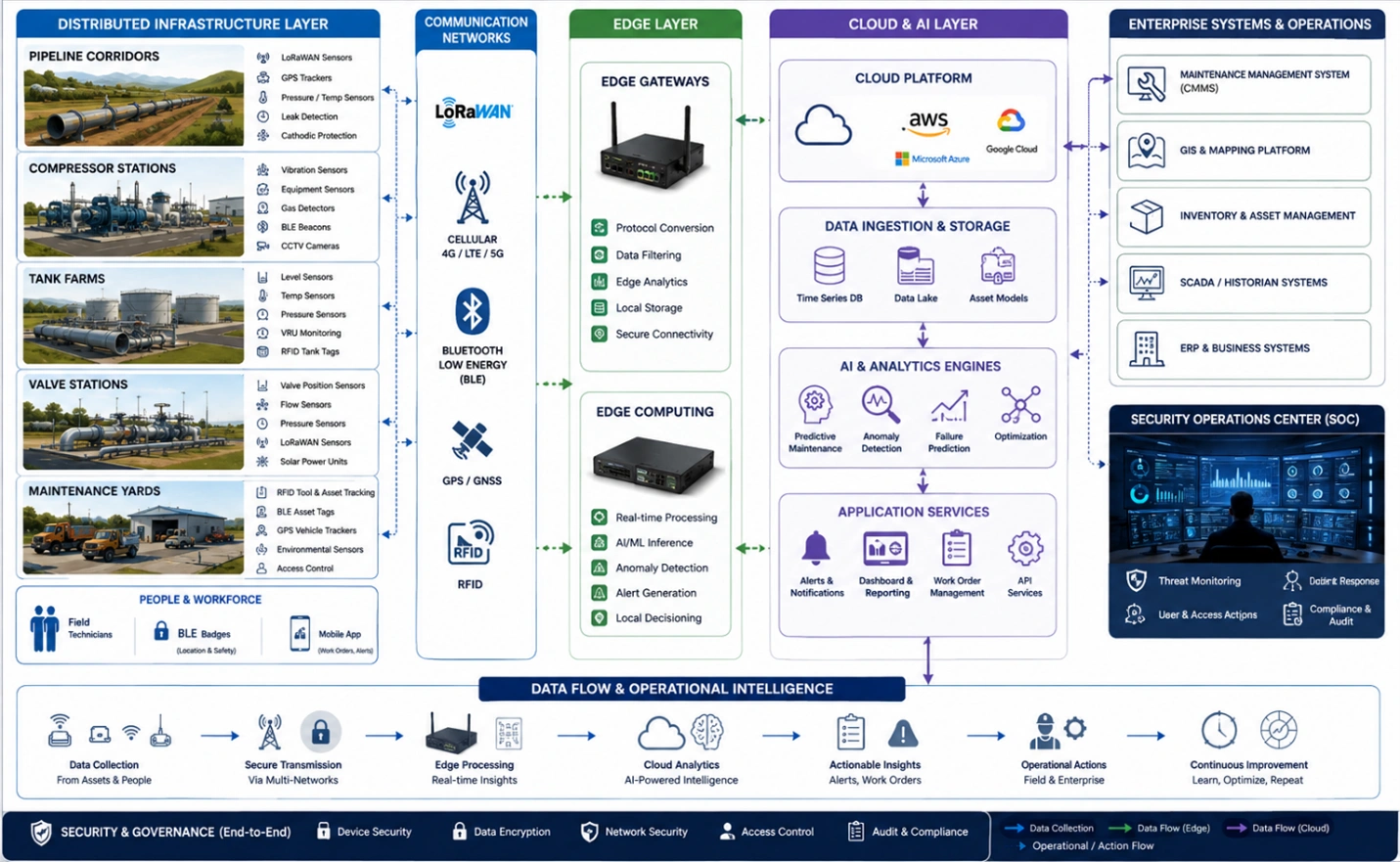
AIoT Enterprise System for Midstream Energy Infrastructure and Real-Time Pipeline Operations
Shows how AI, IoT devices, communication networks, edge computing platforms, cloud analytics, and enterprise systems interact across a distributed midstream energy network. It shows data flows from pipeline corridors, compressor stations, tank farms, valve stations, maintenance yards, and workforce assets through BLE, RFID, LoRaWAN, GPS, and cellular networks into edge gateways and AI-powered cloud platforms. The visual highlights how operational intelligence supports predictive maintenance, asset tracking, GIS integration, inventory management, security monitoring, and enterprise-wide decision-making.
Personnel Safety and Movement Intelligence
Workforce visibility is a critical requirement throughout pipeline transportation and storage operations. Personnel frequently work in remote areas, hazardous environments, confined spaces, and geographically dispersed facilities.
PipeNex AI delivers AI-driven workforce intelligence through BLE badges, wearable sensors, RFID credentials, location beacons, and intelligent monitoring systems.
Workforce Presence Analytics
Real-time visibility of employees, contractors, inspectors, and maintenance teams enables operators to understand workforce distribution across operational assets.
Capabilities include:
- Live workforce location awareness
- Shift attendance verification
- Crew deployment visibility
- Remote site occupancy monitoring
- Workforce utilization analytics
- Geofenced operational zones
Contractor Movement Intelligence
Contractors frequently perform inspections, maintenance, integrity management, and construction activities across pipeline networks.
AI analytics provide:
- Contractor arrival verification
- Worksite duration tracking
- Movement pattern analysis
- Permit-to-work validation
- Safety compliance monitoring
- Restricted area detection
Confined Space Monitoring
Confined spaces remain a significant operational risk within storage terminals, tanks, vaults, and maintenance facilities.
IoT-enabled monitoring supports:
- Entry authorization validation
- Occupancy awareness
- Worker accountability
- Emergency response coordination
- Time-in-space monitoring
- Safety compliance documentation
Emergency Evacuation Intelligence
During gas releases, equipment failures, fires, or operational emergencies, rapid personnel accountability becomes essential.
AI-powered evacuation intelligence provides:
- Muster point verification
- Personnel accountability reports
- Missing worker identification
- Real-time evacuation status
- Emergency response coordination
Facility and Zone Access Intelligence
Physical security remains a major concern throughout midstream operations due to the critical nature of energy infrastructure.
PipeNex AI combines access control technologies with AI-powered analytics to strengthen operational security.
Restricted Zone Access Intelligence
High-risk areas require controlled access.
Examples include:
- Compressor stations
- Control buildings
- SCADA facilities
- Metering stations
- Pipeline control centers
- Storage terminal operations zones
The system continuously validates:
- Authorized personnel access
- Credential compliance
- Access duration
- Unauthorized entry attempts
- Security policy enforcement
Control Facility Access Analytics
Operational control facilities contain critical monitoring and operational systems.
AI-based access intelligence helps organizations:
- Monitor access patterns
- Identify anomalies
- Detect unusual entry behavior
- Strengthen cybersecurity-physical security alignment
Perimeter Security Intelligence
Remote facilities often require continuous monitoring despite limited onsite personnel.
Capabilities include:
- Geofenced perimeter monitoring
- Intrusion detection integration
- Visitor activity tracking
- Security event correlation
- Remote security oversight
Visitor Access Analytics
Visitor management supports:
- Safety orientation validation
- Temporary credential management
- Visitor movement monitoring
- Compliance documentation
- Access history reporting
Critical Asset Tracking and Operational Visibility
Midstream operators manage extensive inventories of mobile and fixed assets across large geographic areas.
PipeNex AI provides real-time asset intelligence using RFID, GPS, BLE, and IoT tracking technologies.
Pipeline Maintenance Equipment Tracking
Field equipment frequently moves between projects and facilities.
Examples include:
- Inspection tools
- Pipeline maintenance equipment
- Pigging equipment
- Welding systems
- Portable instrumentation
- Mobile generators
Tracking capabilities include:
- Asset location visibility
- Utilization analytics
- Movement history
- Asset availability monitoring
- Loss prevention
Valve, Metering, and Instrument Asset Visibility
Critical operational assets require continuous accountability.
AI-enabled tracking helps monitor:
- Metering devices
- Pressure instruments
- Flow measurement systems
- Pipeline valves
- Safety equipment
- Inspection instruments
Fleet and Mobile Asset Intelligence
GPS and cellular technologies provide visibility into:
- Maintenance vehicles
- Inspection fleets
- Emergency response vehicles
- Mobile field units
- Service trailers
Benefits include:
- Route optimization
- Resource allocation
- Asset utilization reporting
- Operational planning support
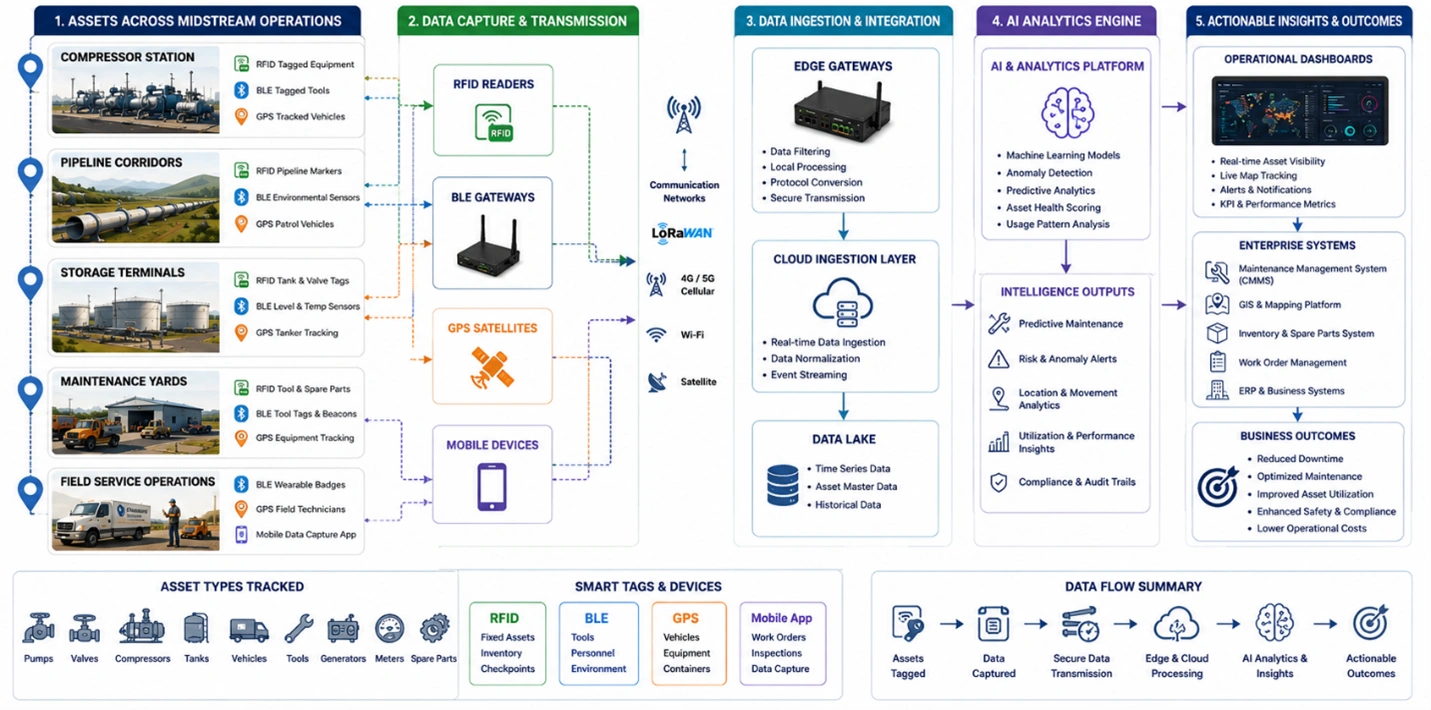
AI-Powered Asset Visibility Workflow for Midstream Energy Operations Using RFID, BLE, and GPS
This workflow diagram demonstrates how RFID tags, BLE beacons, GPS trackers, gateways, and AI analytics collaborate to provide end-to-end visibility of critical assets across midstream energy operations. It follows assets as they move through compressor stations, pipeline corridors, storage terminals, maintenance yards, and field service environments, showing how data is captured, transmitted, analyzed, and transformed into actionable insights. The visual highlights real-time tracking, predictive maintenance, utilization monitoring, compliance reporting, and operational decision support through integrated dashboards and enterprise systems.
Spare Parts and Inventory Intelligence
Maintenance reliability depends heavily on the availability of critical spare parts and operational inventory.
PipeNex AI enables intelligent inventory management across distributed operational sites.
Spare Parts Demand Forecasting
AI analyzes historical maintenance records, operational schedules, asset conditions, and equipment criticality to forecast future inventory requirements.
Benefits include:
- Reduced stock shortages
- Improved procurement planning
- Better inventory allocation
- Lower carrying costs
MRO Inventory Optimization
Maintenance, Repair, and Operations inventory often spans multiple facilities.
AI helps optimize:
- Reorder points
- Safety stock levels
- Multi-site inventory balancing
- Procurement planning
- Inventory turnover
Warehouse Stock Intelligence
RFID and IoT technologies provide real-time visibility into:
- Stock locations
- Inventory movements
- Asset issuance
- Receiving operations
- Warehouse utilization
Critical Spares Availability Analytics
Operational continuity requires immediate access to critical components.
The system monitors:
- Spare inventory levels
- High-priority equipment parts
- Obsolescence risks
- Supply chain disruptions
- Readiness status
Maintenance Traceability and Operational Compliance
Maintenance traceability plays an important role in regulatory compliance, operational reliability, and asset integrity management.
PipeNex AI creates digital records that improve visibility across maintenance lifecycles.
Maintenance Progress Tracking
Operators gain real-time visibility into:
- Scheduled maintenance activities
- Work order completion
- Inspection progress
- Asset servicing status
- Field crew activities
Component Traceability Analytics
Traceability helps organizations understand:
- Equipment history
- Installation records
- Maintenance events
- Inspection outcomes
- Lifecycle performance
Workflow Intelligence
AI provides operational insights regarding:
- Maintenance bottlenecks
- Resource utilization
- Work completion trends
- Operational efficiency metrics
Compliance Traceability Reporting
Digital traceability supports:
- Regulatory audits
- Asset integrity programs
- Inspection records management
- Safety documentation
- Operational reporting requirements
Industrial IoT Infrastructure and Deployment Models
PipeNex AI supports multiple deployment architectures suitable for geographically distributed energy operations.
Edge Data Orchestration
Industrial edge platforms support:
- Local processing
- Low-latency analytics
- Remote facility intelligence
- Network resilience
Interoperability Middleware
Integration capabilities include:
- SCADA systems
- GIS platforms
- CMMS applications
- ERP systems
- Security platforms
- Operational databases
Real-Time Synchronization
Operational data is synchronized across:
- Field locations
- Regional operations centers
- Maintenance organizations
- Enterprise systems
Cloud and Hybrid Deployment
Deployment options include:
- Cloud SaaS environments
- Multi-site cloud integration
- Private cloud infrastructure
- Hybrid architectures
On-Premises Infrastructure
Organizations requiring greater operational control can deploy:
- Local servers
- Dedicated data centers
- Private operational environments
Experience Supporting Energy Infrastructure Operations
PipeNex AI benefits from decades of industrial IoT experience accumulated through large-scale deployments across energy, utilities, and industrial operations. Extensive investments in research and development, rigorous quality assurance practices, and expert engineering support contribute to reliable implementations across complex operational environments.
The organization is supported by highly experienced technical teams, including Ph.D.-level professionals, and draws upon expertise developed through thousands of IoT projects serving industrial enterprises, research organizations, major corporations, and public-sector institutions. Remote and onsite support models help ensure successful deployment and operational adoption.
Why Midstream Operators Adopt AIoT Platforms
Organizations increasingly deploy AI and IoT technologies to improve visibility, safety, security, reliability, and operational efficiency across geographically dispersed infrastructure.
Key outcomes include:
Improved workforce safety
Stronger facility security
Enhanced asset visibility
Better inventory accuracy
Reduced equipment downtime
Increased maintenance efficiency
Stronger regulatory compliance
Improved operational accountability
Faster emergency response
Better utilization of field resources
Ready to Strengthen Your Pipeline Operations?
Connect with PipeNex AI to explore how AI and IoT technologies can improve asset visibility, operational monitoring, safety, and decision-making across midstream pipeline and storage environments